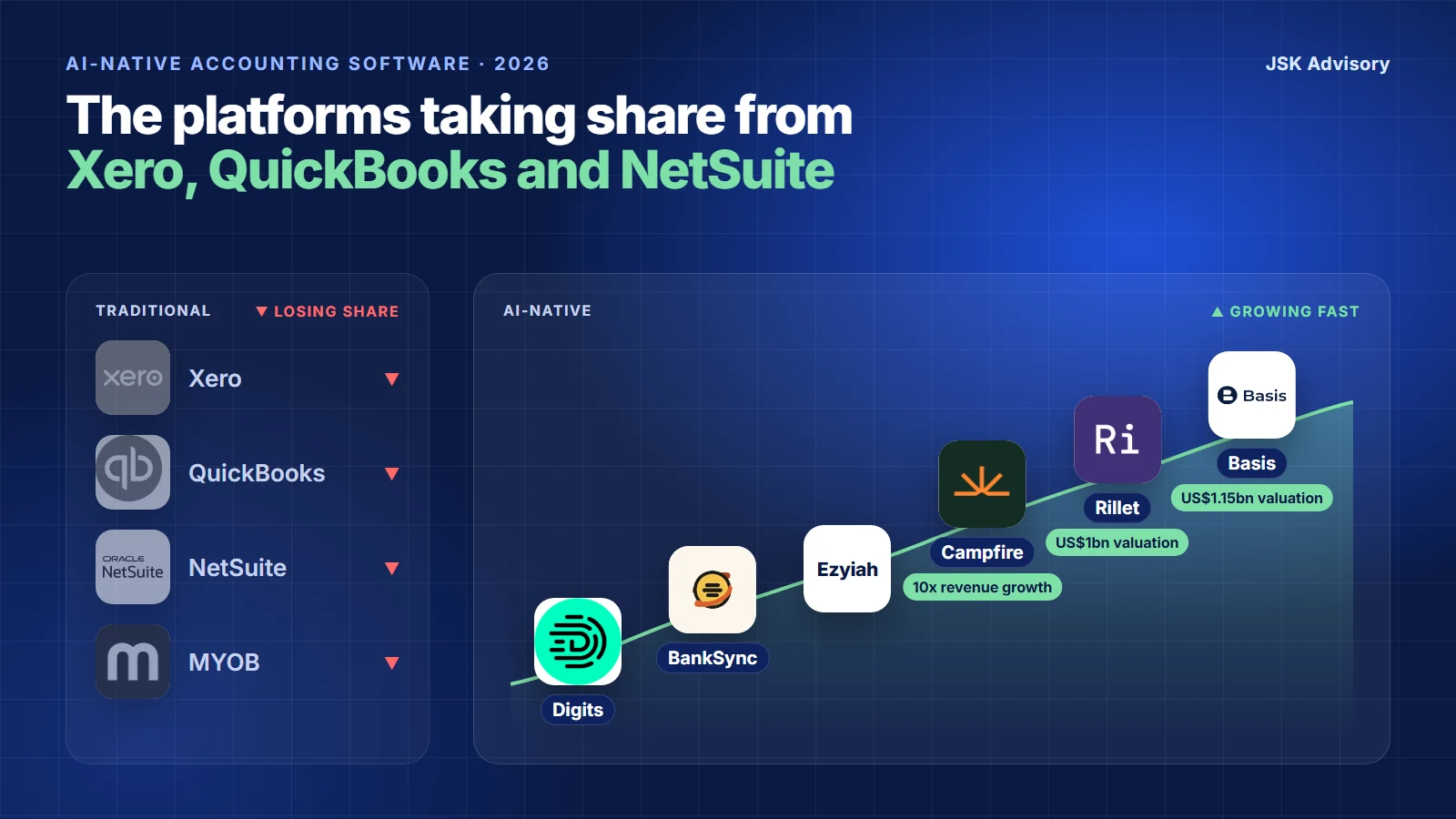
No, but accounting software will become commoditised. Software is now far easier to build than it used to be, and AI tools for accounting are getting easier to learn and implement every few months. As more products enter the market, the tools will start to look alike. What AI won’t replace is the part of an accounting firm that depends on people: managing clients, winning new ones and keeping the human touch. That is where we think firms should be putting their effort now.
Updated November 2026.
What is happening with AI in accounting software right now?
Accounting software providers across Australia are building more AI into their products. Product roadmaps are being rewritten, and new solutions are reaching the market every month.
Outside Australia the shift is further along. In some markets, AI accounting tools are already crowded and starting to look commoditised: lots of products, similar features, and less to tell them apart.
For a firm owner, this creates a familiar problem. Every week there is a new tool to look at, a new feature from an existing provider, or a new pitch promising to automate part of the work. It is hard to know which ones matter.
Why is accounting software becoming commoditised?
Two things have changed.
Bank data is easier to get. Open banking APIs (in Australia, through the Consumer Data Right) let software pull transaction data directly from banks. A lot of what used to make accounting software hard to build was getting reliable bank data in. That barrier is much lower now.
AI has made development faster. A capable developer working with AI can build in weeks what used to take a team much longer.
Put those together and you could build your own accounting software with an open banking API and a custom AI developer, for a fraction of what it once cost. When software is easy to build, more people build it, and the market fills up.
What does a more fragmented software market mean for accounting firms?
We expect accounting software to become more fragmented. Instead of a few large platforms that everyone uses, there will be more products, more niche tools, and more choice.
That has a few consequences for firms:
Software alone won’t set you apart. If any firm can access the same tools, using a particular tool stops being a reason for a client to choose you.
Switching gets easier. More options means clients and firms are less locked in to one platform.
Your client relationships carry more weight. When the tools are interchangeable, the reason a client stays with your firm comes back to the people they deal with.
We have already seen a version of this play out with AI agents. OpenClaw came first. Now simpler platforms like Grokbot are arriving that work out of the box. The first wave needed technical setup. The next wave didn’t. We expect accounting software to follow the same path.
Should accountants still learn AI tools like Claude?
Yes. Upskilling with tools like Claude is worth doing. It helps you understand what AI can and can’t do, and it makes you a better judge of the products being pitched to you.
But it is worth being realistic about where this is heading. Our prediction is that by 2027, AI accounting software will be easier to learn, easier to implement and more accessible than it is today. The technology is improving quickly, and it is only a matter of time before it is commoditised.
So learn enough to use it well and to evaluate it. Don’t build your firm’s future on being the practice that is good at a particular tool, because that advantage will shrink as the tools get simpler.
What gets commoditised, and what doesn’t?
Becomes commoditised
Stays hard
Pulling in bank transactions
Understanding a client’s business and goals
Coding and categorising transactions
Knowing when to call a client, and what to say
Building and setting up accounting software
Winning new clients and building new relationships
Learning and implementing AI tools
Keeping clients through hard years
Producing standard reports
Giving advice a client trusts and acts on
The left column is where most of the AI investment is going. The right column is where most of a firm’s long-term value sits.
Where should accounting firms focus instead?
AI will keep getting easier to use. The hard part will be managing clients, building new relationships and keeping the human touch. That isn’t going away.
In practice, that means:
Use AI to free up time, then spend that time with clients. The benefit of automation is only real if the hours saved go somewhere useful.
Look at how clients experience your firm. How quickly you respond, how often you check in, and whether clients feel known are harder to copy than any software.
Keep investing in new relationships. Referrals, local reputation and the way you win clients will matter more as tools stop being a point of difference.
Avoid over-committing to one tool. In a fragmented market, today’s leading product may not be the one you use in two years.
This is where we are focusing right now across our group of firms.
About the author
John Kim is an accountant and a former account executive at MYOB. At JSK Advisory, he provides growth advisory and AI consulting to accounting firms around the world. For more on the platforms entering the market, see our article on AI-native accounting software.
FAQ
Will AI take over accounting work?
AI will take over more of the routine processing work, like pulling in and coding transactions. It is much less suited to the parts of the job that depend on trust: understanding a client’s situation, advising them through decisions, and building the relationship over years. We expect those parts of the role to become more important, not less.
Is it worth building your own accounting software with AI?
It is now possible to build software with an open banking API and an AI developer for far less than it used to cost. Whether it is worth it depends on your firm. For most firms, the bigger opportunity is using the tools that already exist well and putting the time saved into clients.
When will AI accounting software be easy to use?
Our prediction is that by 2027, AI accounting software will be noticeably easier to learn, implement and access than it is today. The tools are improving quickly, and simpler, out-of-the-box products tend to follow the early technical ones.
Should my firm wait before investing in AI?
No. Learning the tools now helps you understand them and judge what is worth buying. Just avoid locking your firm into one product or treating tool skills as your main advantage, because both are likely to matter less as the market matures.
Share the Article:
Want help getting your firm ready for AI?
Book a free Accounting Firm Audit and we’ll map the right software and AI setup for you.
FYI came out on top. We trialled FYI, Karbon, XBert and SyncHub, tested each against Xero Practice Manager (XPM) and, where possible, against Claude, and FYI gave the best combination of price, ease of use, change management and AI agent connectivity.
Google Ads work for accountants when the setup is tight — the buyer intent is already there. Here’s why they convert so well, how they pair with local SEO, and what a setup that actually works looks like.